Discover our different golf courses near Brides-les-Bains
Do you want to explore the grass and face the sand and water obstacles?
If you dream of an introduction to golf or simply of practising your passion on prestigious high-altitude courses, Brides-les-Bains will guide you to swing at the top of your game!
Méribel Golf Club
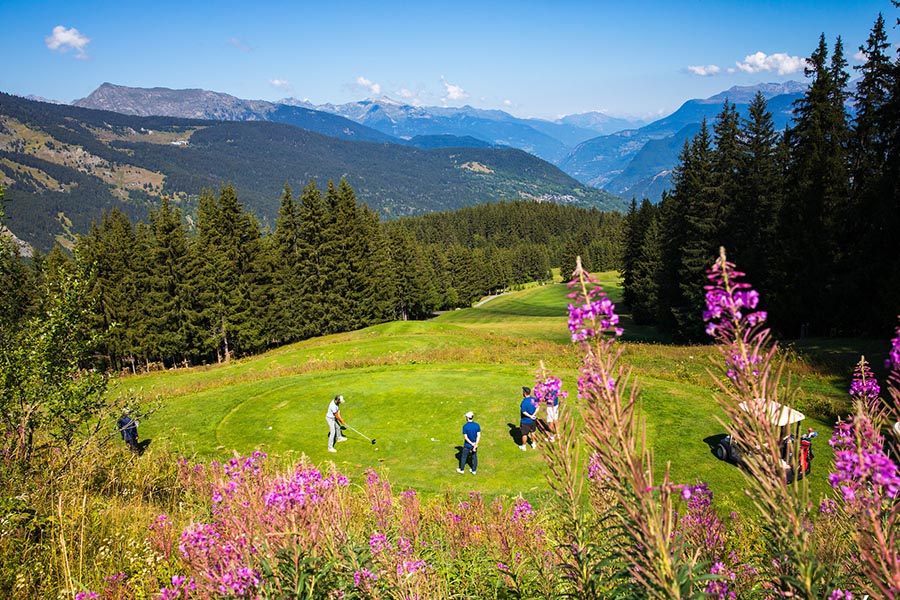
Among the golf courses near Brides-les-Bains, Méribel is considered one of the most beautiful European spots to play this fun mountain sport.
Located less than 20 kilometres from the spa, this 18-hole course features greens, fairways, water basins and bunkers in a wonderful setting, at nearly 1,700 metres high.
Created in the countryside in 1978, this par 71 course has since had its first 9 holes redesigned, for a distance now reaching 5,540 metres.
With a rather physical and quite technical orientation, it is nevertheless open to all (from the beginning of June to the end of October) and appeals to both amateurs and golf professionals.
Courchevel Golf Club
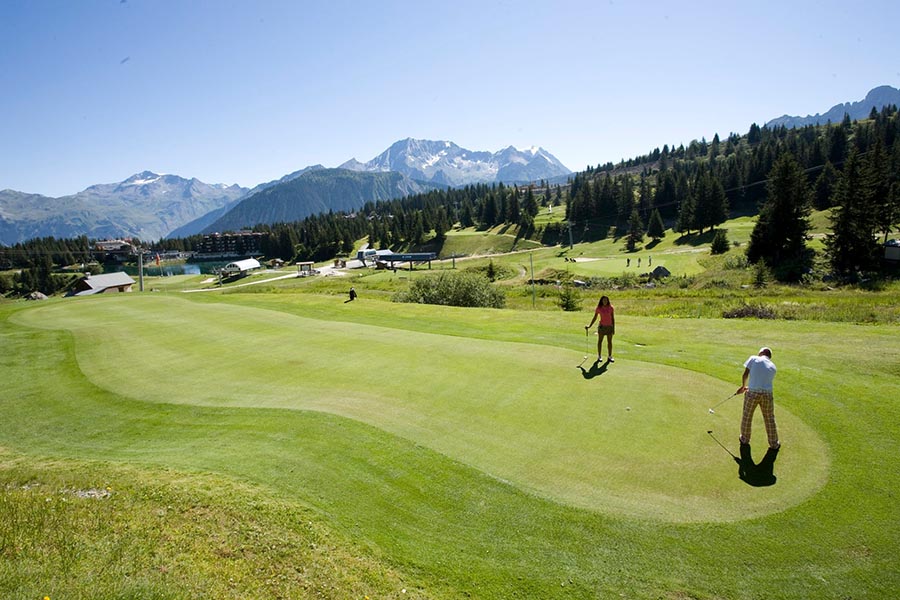
Courchevel’s 9-hole course, which can be accessed fairly quickly from Brides-les-Bains, covers a total distance of 1,140 metres (from the “Back Tees”).
With a par 27 it offers a superb view of the Rosière lake from the start and unfolds throughout the course in a special natural setting.
Individual and team competitions are regularly held here at weekends and some great records have been set.
This technical and unique French Golf Federation approved course, which can be played on from the end of June to October, helps you improve your index.
Les Arcs Golf
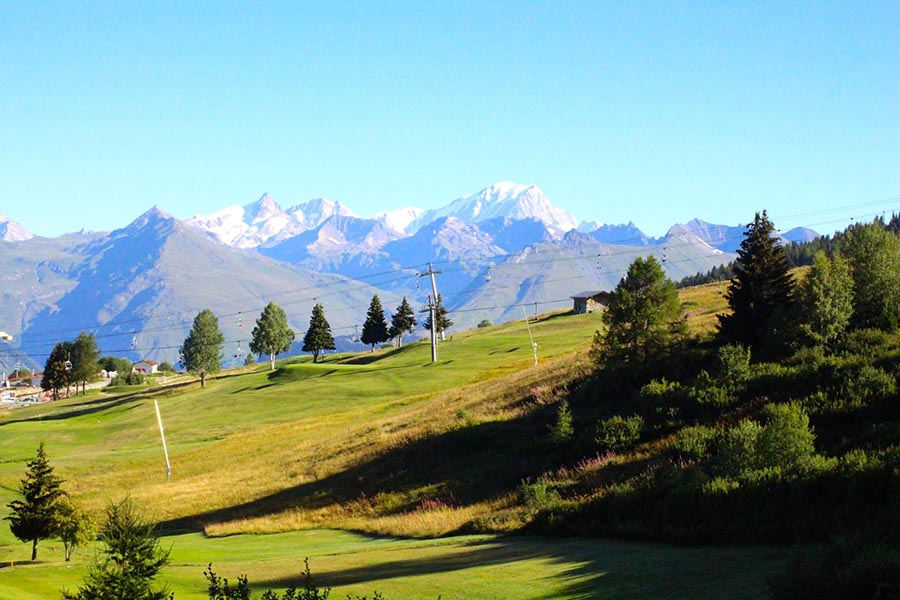
About an hour’s drive from Brides-les-Bains, Les Arcs Golf dominates the upper Tarentaise valley. At the gateway to the Vanoise Park, opposite Mont Blanc, it spreads over 60 hectares for the greatest enjoyment for golfers.
Two exceptional courses are open to all golfers: the 18-hole course (par 70) at 5,497 metres and the 9-hole course (par 27) at 860 metres.
A driving range and three putting greens (including one with bunkers) also allow you to practice golf, warm up before teeing off and improve your skills in a fun and relaxed way.
Tignes Golf
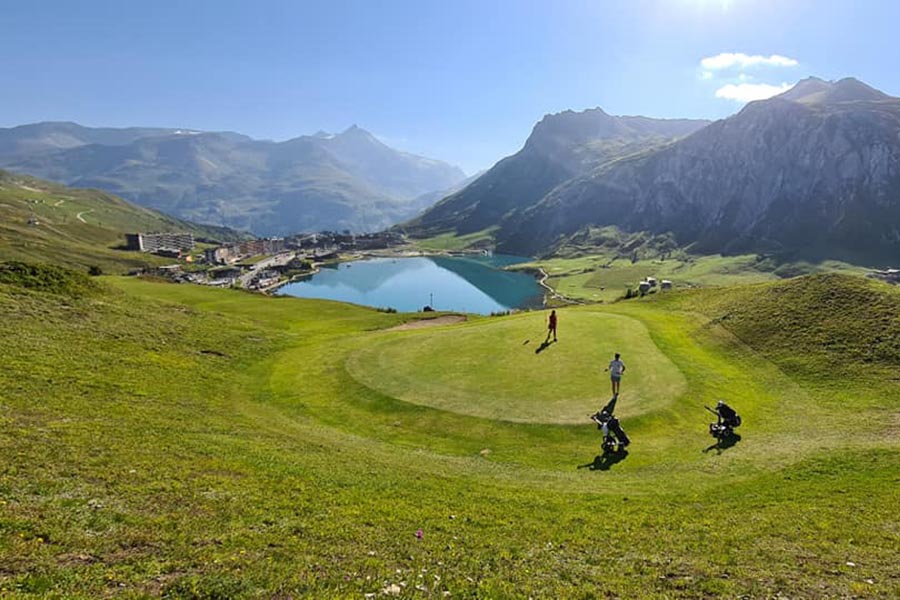
From Brides-les-Bains, the 18 holes at Tignes is not far away! Below the Grande Motte glacier, the highest golf course in Europe has an exceptional view of Tignes lake and of the marmot burrows which can be seen around the fairways!
Another original feature is that every two years Tignes Golf organises a "high-flying" competition on a mountain pass 270 metres above the course! Like Les Arcs Golf, it is open from the end of June to the beginning of September.
Preparing a golf course
Golf is a moment of sharing that can also provide some thrills. It requires a number of physical and mental qualities. Requiring specific equipment, the activity requires a few rules to be applied.
Requirements for playing golf
You need to be in good physical shape to play the many kilometres of a golf course with ease, especially if it is on a steep slope! As a guide, a round lasts around four hours and is equivalent to burning an average of 800 calories (which varies depending on the level of the course).
Playing puts a lot of strain on certain joints, and muscular strength and flexibility are directly involved in the golfer’s performance.
Mastering anxiety, attention, concentration, reaction skills and spatial awareness also impact on the level of play.
Basic equipment for golf
Obviously, the golf club is essential for the shot and must match your level and your body shape. Basic equipment usually consists of 6 irons, plus a golf putter (to make your last shots on the greens).
Balls can be bought new or second hand (it is important to take into account the inevitable losses, especially when starting out!)
A glove, tees (to position the ball for the first shot) and specific shoes complete the outfit.
Level of difficulty, the slope
Corresponding to the level of difficulty of a golf course, the slope is a key factor.
Among the hundred or so criteria taken into account to determine it, the main ones are: the distance between the tee zone and the flag, the topography of the course, the obstacles, the playing area: the rough where the thick and long grass makes it difficult to play, the quality of the green, the trees and vegetation that dot the course, the climate, the presence of regular wind etc.
Some golf rules
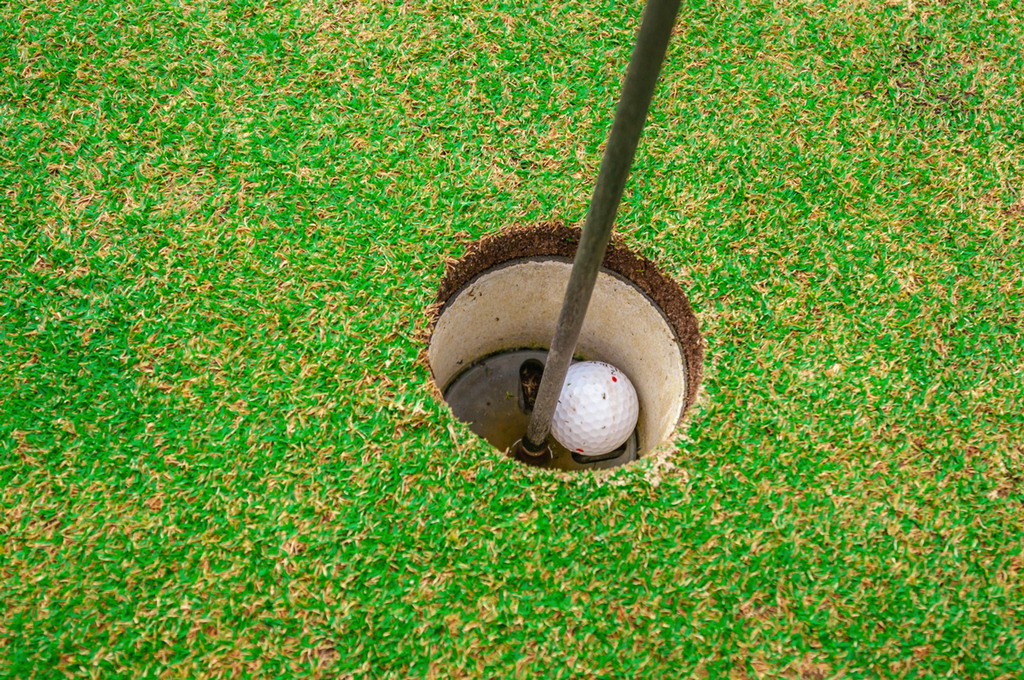
• Points: are scored according to the number of strokes played to get the ball into the hole. The winner is the player who completes the course with the fewest strokes.
• Difficulty: The usual indications ''Par 3'', ''Par 4'' and ''Par 5'' specifies the number of strokes required to complete a hole. If the golfer exceeds the predetermined number, they play “Over Par”. If they don’t exceed the predetermined number, they play “Under Par”.
• The tee markers: Having recently been developed, there are six of them, illustrated by colours. These markers mean players can tee off according to their level, age, level of difficulty etc.
• Rules to follow in the tee off zone: keep quiet so that players can concentrate, avoid moving, don’t cast a shadow over others’ balls.
• Order of play: the player who starts is the one whose ball is furthest away from the flag. Then, the player who won the previous hole is always the first to start again.: le joueur qui commence est celui dont la balle est la plus éloignée du drapeau. Ensuite, c’est toujours le joueur qui a remporté le trou précédent qui recommence en premier.
A stay in Brides-les-Bains to play golf
Whether on holiday or for a short break, Brides-les-Bains is the perfect base camp for accessing the best mountain golf courses in Savoie!
Both a spa and winter sports resort, the village has a wide range of quality accommodation and facilities.
To learn golf or perfect your professional swing in a friendly atmosphere, “get yourself on the green” in Brides-les-Bains!
Historical Aime
Descriptive
Known as Axima during the Roman Empire, Aime has always been a transit town, for commerce first of all and then for tourism. The small town continues the Savoyard tradition of welcoming visitors and offers a number of curiosities to discover.
Saint-Martin Basilica
The Romans envied this Tarentaise valley, conveniently located on the road linking Milan to Vienne (France). They envied the microclimate, and were already talking about the pretty little red cows (the tarine or tarentaise breed), whose milk made such a good cheese: caesum vatusicum, the ancestor of tomme.
Clever strategists, they subdued the Gallic-Ceutrons around 21 BC, and made Aime, under the name of Axima, the capital of the province of Alpes Graies, which covered part of present-day Savoie and Haute Savoie.
In addition to objects in the Pierre Borrione Museum, we still have the foundations of a Roman building from this period. Destroyed by a flood on the Ormente, the first Christians built a church on these ruins. Destroyed by fire, the builders of the year 1000 erected on the same site a jewel of Savoy Romanesque art: L'Eglise du Prieuré Saint Martin. Listed as a historic monument since 1875, it has not been a place of worship for several centuries.
Don't miss: the 13th-century frescoes in the choir, the Roman engraved stones, the semi-subterranean crypt and the temporary exhibitions.
Château Montmayeur
The original construction of this keep was a square tower protected by an enclosure.
In feudal times, the great lordly families shared the territory, and the Montmayeur family, like the Count of Savoy, was a vassal of the Holy Roman Empire.
Located at the bottom of the town, it controlled the flow of the Isère river.
With the evolution of weaponry, the medieval tower no longer fulfilled its defensive role. A main building, a turret housing a spiral staircase, and a few interior alterations turned the keep into a pleasant residence during the Renaissance. Abandoned over the centuries and finally bought back by the commune, it now houses exhibitions.
Don't miss:
On 3 levels, models, drawings and sound archives reveal the secrets of the valley's traditional buildings, from village houses to alpine chalets.
The cellar tells the story of wine-making in the Middle Ages, as well as the tools used to work the land.
In the main building, you can re-enact a scene from medieval life.
Translation game of a medieval text.
Audiovisual screen showing the "Shared Kingdom" documentary by Pascal Bellemin-Bertaz and Didier Bouillot (French and Italian versions).
Aime archaeological museum
At the summit of the ancient Gallic oppidum, with a remarkable view over the valley and surrounding peaks, the archeological museum is unique in that its exhibits are housed in a former church.
The story begins in the Neolithic and gallops right up to the present day.
The area is named after the visionary mayor of Aime, who, in anticipation of the closure of the La Plagne mines, rallied other communes around him to found the La Plagne resort.
Today, the Société d'Histoire et d'Archéologie d'Aime manages the museum's collections, which are classified as a Musée de France.
Visits and reception are provided jointly with Plagne Vallée.
Practical Information
Opening Times :
From 01/07 to 30/08.Basilique Saint-Martin & Château Montmayeur: Tuesday to Saturday, 10am to 1pm and 2.30pm to 6pm
Musée archéologique: Wednesday to Friday, 10am to 1pm and 2pm to 5pm.
Languages spoken :
- French
Tariffs
Guided tour of the buildings (outside the summer period): upon request in advance and subject to guide availability